Learn how to buy a car with bitcoin by borrowing stablecoins against your BTC instead of selling. The 2026 math, LTV, tax angle, and when a 0% auto loan wins.
 Arkadii Kaminskyi
Arkadii Kaminskyi
Head of Operations at Sats Terminal
Head of Operations at Sats Terminal with 5 years of experience in crypto. Specializes in DeFi, yield farming, and borrowing — has reviewed 50+ crypto products.
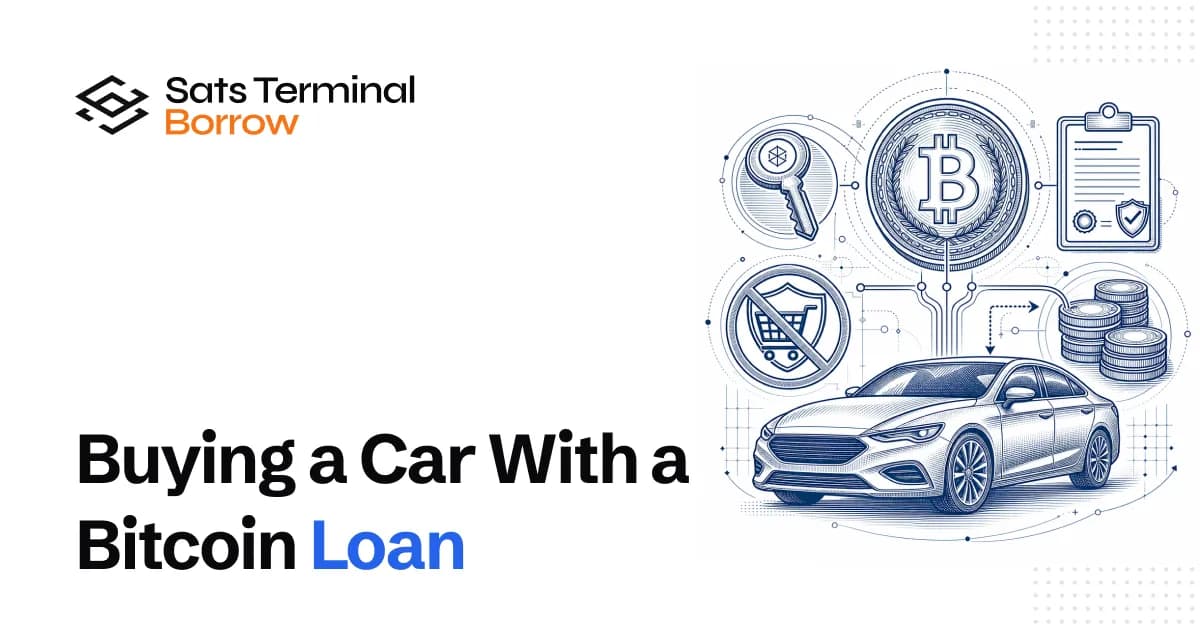
There is a specific kind of decision that trips up long-term holders: you want a new car, you have the Bitcoin to pay for it many times over, but selling feels like a mistake. Sell, and you trigger capital gains and permanently give up the upside on coins you have held for years. So the question becomes whether you can buy a car with bitcoin without actually parting with the BTC. You can, and the mechanism is more boring (in a good way) than most people expect: you pledge your Bitcoin as collateral, borrow stablecoins against it, convert those to dollars, and pay the dealer. Your BTC stays yours. This guide walks through both realistic paths to financing a vehicle with crypto, the real math against a normal auto loan, the tax angle, and the honest risk of pledging volatile collateral against a depreciating asset.
This is a use-case how-to, not a pitch. By the end you should be able to tell whether a bitcoin car loan actually beats the 5.9% the dealer is offering you, or whether you are about to make a clever-looking financial mistake. We will be specific about numbers, hedge where prices move, and tell you plainly when the smart move is to take the boring auto loan and leave your stack alone.
The appeal is not complicated, and it is worth stating clearly because it is the entire reason this strategy exists. When you sell Bitcoin to buy something, two things happen at once. First, you realize a capital gain (or loss) on the difference between your cost basis and the sale price, which the IRS treats as a taxable event. Second, you permanently exit the position, so any future appreciation on those specific coins is gone. Borrowing sidesteps both.
None of this is free, and a depreciating asset changes the calculus in ways a mortgage or an investment purchase does not. We will get there. First, the two concrete ways to actually do it.
Rule of thumb: Borrowing against BTC to buy a car only makes sense if you genuinely believe in your Bitcoin's long-term appreciation and you keep the loan-to-value low enough that a 40% drawdown will not liquidate you. If either is shaky, this is not the move.
This is the cleanest and most common route. You never sell a satoshi. The flow is identical whether you are buying outright or just funding a down payment; only the borrowed amount changes.
The part people underestimate is converting USDC to spendable dollars. As of early 2026 the practical routes for US users look roughly like this, though terms change and you should confirm current fees before you commit:
| Off-ramp route | Typical fee | Speed | Notes |
|---|---|---|---|
| Coinbase USDC→USD, ACH withdrawal | Free conversion, free ACH | 1–3 business days | 1:1 USDC redemption; cheapest if you can wait |
| Coinbase wire withdrawal | ~$25 outbound | Same day | Good when a dealer needs funds fast |
| Coinbase instant card payout | ~1.5% | Minutes | Expensive; avoid for large sums |
| Kraken USDC→USD, wire | ~$4 outbound | Same day | Tight spread; RTP/FedNow where supported |
Full KYC (government ID plus a selfie) is required before any fiat withdrawal at every regulated venue, so factor a day or two for verification if you have never used the exchange. For a roughly $40,000 purchase, off-ramp friction is usually a rounding error: free or a few dollars by ACH, or about $25 by same-day wire. The bigger cost is always the loan interest, which we model next.
Tip: Start the KYC and the off-ramp before you are standing in the dealership. Nothing kills a negotiated price faster than telling a salesperson your funds are stuck in a 1–3 day ACH window. Have the cash sitting in your checking account first.
The honest comparison is not "crypto loan good, bank loan bad." It is a rate-and-terms decision, and sometimes the bank wins outright. A bitcoin backed auto loan is really just a general-purpose stablecoin loan you happen to spend on a car, so it competes against whatever financing the dealer or your credit union offers.
| Feature | BTC-backed stablecoin loan | Traditional / dealer auto loan |
|---|---|---|
| Typical rate (early 2026) | ~5–13% APR depending on platform & LTV | ~6–7% new, ~10% used (avg); 0–4.66% for super-prime promos |
| Credit check | None — collateral-based | Yes; rate scales with credit score |
| Collateral | Your BTC (volatile) | The car itself (depreciating) |
| Liquidation / repossession risk | If BTC price falls and LTV breaches threshold | If you miss payments |
| Capital-gains impact | None from borrowing | None (you did not sell anything) |
| Repayment schedule | Flexible; often interest-only, repay principal anytime | Fixed monthly amortization, 36–72 months |
| Keeps BTC upside | Yes | Yes, if you did not sell to fund it |
Two things jump out. First, a borrower with excellent credit can often beat a crypto loan rate with a standard auto loan, especially if a manufacturer is running a promotional 0% or sub-5% offer. Second, the crypto loan's advantage is not really the rate; it is the absence of a credit check and the flexible, interest-only repayment that lets you avoid forced monthly amortization. If you are self-employed, between W-2 jobs, or simply do not want a hard inquiry and a new line on your report, that flexibility has real value.
This deserves its own callout because it is the single most common mistake. If a manufacturer offers you a true 0% APR (or anything meaningfully below your crypto loan rate) and you qualify, taking it is almost always correct. You get to keep your BTC and pay nothing for the financing. There is no scenario where borrowing at 9% to avoid borrowing at 0% makes sense.
If you want a broader cost framing, our piece on crypto loan vs credit card walks through how collateralized borrowing stacks up against unsecured consumer debt, and the same logic applies to financing a vehicle.
Let us run a realistic worked example. Numbers are illustrative for early 2026 and Bitcoin's price moves constantly, so treat the dollar figures as a template, not a forecast.
At a 25% loan-to-value ratio, borrowing $40,000 requires $160,000 of collateral, which is 1.6 BTC at $100k. That feels like a lot of Bitcoin to lock up against a $40k car, and it is — deliberately. The low LTV is your liquidation buffer. If you instead borrow at 50% LTV you only pledge 0.8 BTC, but you have far less room before a price drop puts you in danger.
Suppose the protocol liquidates positions that breach an 80% LTV threshold (Aave-style for a BTC market; exact thresholds vary by venue and asset). Your $40,000 debt hits 80% LTV when your collateral falls to $50,000. Starting from $160,000 of BTC, that is a 69% collapse in price — from ~$100k to ~$31k per BTC. You have an enormous cushion. Now compare the aggressive version:
| Scenario | BTC pledged | Starting LTV | Liquidation at ~80% LTV | BTC price drop to trigger |
|---|---|---|---|---|
| Conservative (recommended for a car) | 1.6 BTC ($160k) | 25% | Collateral ~$50k | ~69% drop (to ~$31k) |
| Moderate | 1.0 BTC ($100k) | 40% | Collateral ~$50k | ~50% drop (to ~$50k) |
| Aggressive (don't) | 0.8 BTC ($80k) | 50% | Collateral ~$50k | ~38% drop (to ~$62k) |
Bitcoin has fallen 38% in a matter of weeks more than once in its history. For a depreciating asset you cannot easily re-sell to cover the gap, the aggressive column is genuinely dangerous. The conservative column survives a brutal bear market. If you want the full mechanics, our sibling guide on calculating your liquidation price shows the formula step by step.
At 9% APR on $40,000, interest runs $3,600 per year, or $300 per month if you make interest-only payments. If you keep the loan three years and repay principal at the end, that is roughly $10,800 in interest — before you reclaim every satoshi of your BTC. Compare that to a 6.9% new-car auto loan on $40,000 over 60 months, where total interest is in the neighborhood of $7,300 but your BTC stays untouched either way (you would not have sold it to take the auto loan). And compare both to a 0% dealer promo, where your financing cost is zero.
Here is the framing that cuts through the rate noise. The crypto loan's premium over a cheap auto loan — call it the difference between 9% and 6.9%, roughly $840 per year on a $40,000 balance — is the price you pay to not realize a capital gain and not exit your Bitcoin position. So the real question is whether your BTC's expected appreciation, plus the deferred-tax benefit, is worth that spread. If you bought BTC years ago at a low cost basis, selling $40,000 of it could mean a five-figure tax bill on its own; against that, an $840-a-year financing premium can look cheap. If your cost basis is high or your conviction is low, the spread is just money you are lighting on fire to keep a position you do not strongly believe in.
This is the same logic that powers the broader strategy of getting cash without selling Bitcoin: borrowing is rarely the cheapest way to get dollars, but it is frequently the most tax-efficient and the only one that preserves your upside. For a car specifically, run the numbers honestly — the answer is genuinely situational, and there is no shame in concluding that a plain auto loan wins.
The uncomfortable truth: On rate alone, a prime-credit borrower usually pays less with a normal auto loan than with a 9% crypto loan. The crypto loan wins on flexibility, privacy, and not needing a credit pull — not on headline cost. Be honest with yourself about which you are actually buying.
This is the section that separates a thoughtful borrower from someone about to get hurt. A mortgage or an investment purchase has a built-in defense: if things go wrong, the house or the portfolio still has value you can sell to repay the loan. A car does not. The moment you drive it off the lot it has shed value, and you cannot liquidate it quickly to cover a margin call on your Bitcoin.
When you borrow to invest — say, to diversify without selling BTC — the borrowed funds buy something that can appreciate and help repay the loan. When you borrow to consume (a car, a vacation, a wedding), the money is gone and the loan still has to be serviced from your income. There is no offsetting asset growing on the other side. That asymmetry is exactly why a car purchase deserves a more conservative LTV than a yield play or a rebalance. For a deeper treatment of choosing the right ratio, see our explainer on optimizing your LTV ratio.
Warning: Never finance a depreciating asset at the maximum LTV a protocol allows. Maxing out is for sophisticated, actively-managed positions, not for a commuter car you will not check daily. Keep a buffer that survives a 50%+ BTC drawdown without you needing to do anything.
Here is the full sequence, assuming the conservative-LTV approach. The mechanics are the same on most platforms; an aggregator like Borrow by Sats Terminal exists to find you the cheapest rate across them so you are not manually checking each one.
Buying outright maximizes the no-credit-check, no-monthly-amortization benefit but requires more collateral and exposes the whole purchase to your crypto loan rate. Funding only a down payment with a BTC loan and financing the rest at a low dealer rate can be the best of both worlds, especially if the dealer offers a sub-crypto-loan APR. A car down payment with bitcoin is a perfectly reasonable hybrid.
On DeFi you will wrap BTC into wBTC or cbBTC and supply it to Aave or Morpho. On CeFi you transfer native BTC to a lender's custody. Each has trade-offs around counterparty risk, rates, and convenience; our overview of DeFi vs CeFi lending covers them, and the comparison applies directly to picking a venue for a car loan.
Pledge enough BTC that your starting LTV is in the 20–30% range for a vehicle. Confirm the platform's liquidation threshold and note the exact BTC price at which you would be liquidated. Write it down.
Draw the stablecoin amount you need — the full price for an outright buy, or the down payment for a hybrid. Prefer a widely-supported, transparent stablecoin; our guide to USDC/USDT loans against BTC covers the differences that matter here.
Send the stablecoins to a KYC'd exchange, convert to USD, and withdraw by ACH (free, slower) or wire (small fee, same-day). Time this so the cash lands before you finalize the purchase.
Pay the dealer or seller by wire, cashier's check, or however they accept funds. Keep records of the loan and the off-ramp for your tax file.
Track your position's health as BTC moves. If price falls toward your liquidation zone, top up collateral or repay principal early. When you are ready, repay the loan in full to release your Bitcoin. Our walkthrough on monitoring loan health covers what to watch and how often.
The tax story is the headline reason many holders choose to borrow rather than sell, so it is worth getting right — while being clear that this is general information, not tax advice, and rules change.
Under current IRS treatment, loan proceeds are not income because you have to pay them back. Taking a Bitcoin-backed loan to buy a car does not, by itself, create a capital gain or require you to report anything. You received cash, but you also took on debt, exactly like a home-equity loan or a margin loan. This is the crux of the avoid-a-taxable-event strategy: you access your Bitcoin's value without realizing the gain that a sale would trigger.
For a fuller treatment, see our deep dive on the tax implications of crypto borrowing and the FAQ on tax implications of borrowing against Bitcoin. Confirm your specifics with a qualified tax professional — especially if you are in a different jurisdiction.
Regional note: In the EU, stablecoin availability shifted under MiCA. As of 2026, Circle's USDC and EURC are MiCA-compliant while Tether's USDT has been delisted for EEA retail users on major exchanges. If you are borrowing in Europe, you will likely off-ramp through a compliant stablecoin and a licensed provider — see our overview of crypto loans in Europe under MiCA.
You do not have to use BTC. The same playbook works to finance a car with crypto generally. If you hold Ethereum or Solana you can borrow against those instead, though the volatility profile (and therefore the safe LTV) differs.
| Collateral | Illustrative 2026 price | Volatility vs BTC | Suggested LTV for a car |
|---|---|---|---|
| Bitcoin (BTC) | ~$100k | Baseline | 20–30% |
| Ethereum (ETH) | ~$3,000–$4,000 | Higher | Lower than BTC |
| Solana (SOL) | ~$150–$220 | Higher still | Lower again |
The more volatile the collateral, the wider the buffer you need, so a SOL-backed car loan should run an even more conservative LTV than a BTC one. If you mostly hold ETH, our guide on borrowing against Ethereum covers the specifics. The principle is constant: match your LTV to your collateral's downside, and keep it conservative because a car cannot bail you out.
Run yourself through this before you pledge anything. If you cannot clear all four, take the boring loan.
If you are weighing this against the broader "should I even borrow against my coins" question, our sell-or-borrow decision framework is the right companion read, and how to live off your Bitcoin without selling it zooms out to the lifestyle-financing version of the same idea. If you are still figuring out the best general use of borrowed stablecoins, seven smart ways to put a crypto loan to work puts a car purchase in context alongside other use cases.
One more honest filter: think about how long you actually plan to hold the loan. A crypto loan with flexible, interest-only repayment is forgiving if you intend to repay principal in a lump sum — say, after a bonus, an equity vesting event, or a planned partial BTC sale at a future date you have chosen deliberately. It is far less attractive if you would otherwise be paying a fixed auto loan down to zero over five years and never thinking about it again. Match the product to your temperament: if you do not want to monitor a position, the set-and-forget auto loan exists for a reason.
Common Questions
Directly, only at a limited set of dealers that use processors like BitPay to convert crypto to dollars at checkout. The more practical and tax-efficient route is to borrow stablecoins against your Bitcoin, off-ramp those to USD in your bank account, and pay the dealer or seller in plain cash. Your BTC stays as collateral and you reclaim it when you repay the loan.

