Wondering what to do with a crypto loan? Seven smart uses for borrowed stablecoins in 2026 - with the math, the risks, and the LTV discipline to make each one work.
 Arkadii Kaminskyi
Arkadii Kaminskyi
Head of Operations at Sats Terminal
Head of Operations at Sats Terminal with 5 years of experience in crypto. Specializes in DeFi, yield farming, and borrowing — has reviewed 50+ crypto products.
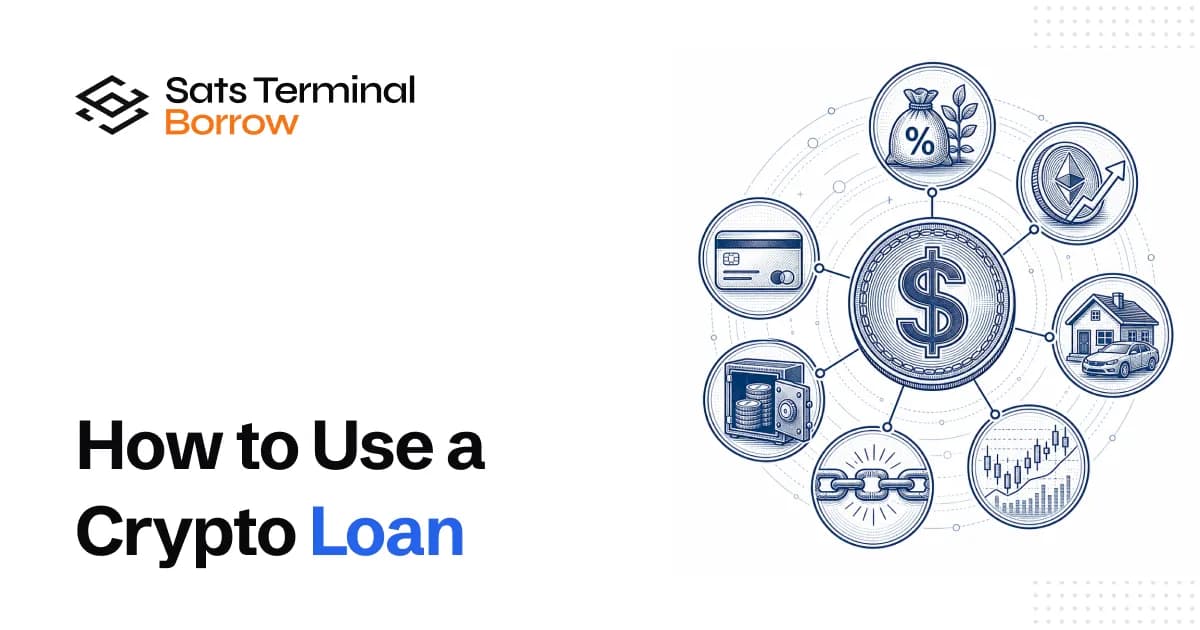
So you borrowed dollars against your bitcoin — or you are thinking about it — and now the practical question is the one nobody answers well: what to do with a crypto loan once the stablecoins land in your wallet. Taking the loan is the easy part. Deploying the cash in a way that earns its keep, survives a 30% drawdown, and does not blow up your collateral is where most borrowers either win or quietly destroy themselves. This guide is a practical roundup of the seven highest-value uses for a crypto loan, plus the uses you should avoid entirely. For each one we cover when it actually makes sense, the math, and the specific way it can go wrong. The throughline that ties every smart use together is loan-to-value discipline — your LTV is the single dial that decides whether borrowed stablecoins are a tool or a trap.
None of this is financial, tax, or legal advice. Rates, protocol parameters, and tax rules move constantly, and bitcoin is volatile — as of mid-2026 it has swung through a wide band, so treat every number here as a worked illustration, not a promise. Always check current terms before you act. With that out of the way, let us get into the uses.
Before we list uses, you need the one fact that makes all of them possible. When you borrow against bitcoin you keep ownership of the BTC. You are not selling, so under current U.S. tax principles you are generally not triggering a capital-gains event — borrowing is not a realization event, the same way a home-equity loan is not income. That is why so many long-term holders borrow instead of sell: a sale crystallizes a tax bill and ends your upside, while a loan keeps both. (Caveats matter — liquidation of your collateral, or repaying the loan with appreciated crypto, can each create a taxable disposition. We cover the deeper mechanics in our guide to the tax implications of crypto borrowing, and you should confirm specifics with a tax professional.)
The cost side is equally important. Borrowed dollars are not free. On the DeFi venues that an aggregator compares, stablecoin borrow rates have generally sat in a roughly 3%-8% APR range through 2026 depending on protocol and pool utilization, with Morpho markets often at the cheaper end and Aave variable rates moving with demand block by block. CeFi lenders typically quote higher, fixed rates. The point of every section below is simple: a use is "smart" only when the value it creates clearly exceeds your borrow cost and the risk of a forced liquidation. If you keep that test in mind, the rest is just bookkeeping.
The one rule that governs everything: Borrow at an LTV low enough that a normal bitcoin drawdown cannot liquidate you. As of 2026 a 30%-40% single-month BTC move is well within recent history. If your liquidation price sits inside that band, you are not investing — you are gambling on timing.
For each of the seven uses, hold two questions in your head. First, time horizon: is this a short, defined need (a one-off purchase you will repay in months) or an open-ended position you will carry for years? Short horizons tolerate higher LTVs because you are exposed to volatility for less time. Second, does the use produce a return, save a cost, or simply spend? Yield and debt-payoff produce a measurable spread; tax avoidance and emergencies save a cost; lifestyle spending just burns the principal. The smartest uses cluster in the first two buckets. Here is the summary table you can skip ahead to, then we will walk each one.
| Use case | Typical time horizon | Risk level | What it does for you | Suggested starting LTV |
|---|---|---|---|---|
| Avoid a taxable sale for a big purchase | Short to medium | Low-moderate | Saves capital-gains tax, keeps BTC upside | 20%-30% |
| Accumulate more BTC / DCA (leverage long) | Long | High | Amplifies gains and losses | 10%-20% (or skip) |
| Earn DeFi yield on borrowed stablecoins | Flexible | Moderate-high | Captures a yield-minus-borrow spread | 20%-30% |
| Business working capital / payroll / runway | Short to medium | Moderate | Funds operations without selling treasury | 20%-35% |
| Real-estate down payment / renovation | Medium | Moderate | Funds a hard asset, keeps BTC exposure | 20%-30% |
| Emergency / medical / one-off liquidity | Short | Low-moderate | Fast cash without a fire sale | 15%-25% |
| Pay off high-APR credit-card debt | Short to medium | Low-moderate | Swaps ~21% APR for single-digit borrow cost | 20%-30% |
This is the flagship use case and the one with the cleanest math. Say you hold bitcoin you bought years ago at a low basis, and you need $40,000 for a major purchase — a car, a wedding, a tax bill, a tuition payment. If you sell BTC to raise the cash, you realize a capital gain and hand a slice of it to the tax authorities, then you no longer own the bitcoin. If you instead borrow $40,000 against the BTC, you keep every satoshi, you pay no capital-gains tax on the borrowing, and you owe only interest. For a holder with a large embedded gain, the tax saved can dwarf years of interest.
Assume BTC is around $100,000 (it moves — treat this as illustrative). You hold 1.5 BTC worth roughly $150,000, bought at $30,000 for a $105,000 unrealized gain. You need $40,000.
In this example the borrow route is cheaper in year one and preserves your BTC. The decision tilts toward borrowing whenever your interest cost over the time you will carry the loan is less than the tax you would pay on the sale — a calculation we break down further in our sell-vs-borrow decision framework. This use also gets its own deep dive in avoiding a taxable event with a BTC loan.
The risk: a loan is not free money. You still have to repay it or refinance it, and the collateral can be liquidated if BTC falls and your LTV climbs past the threshold. At 27% LTV you have substantial cushion, but you must monitor it. This is why tax-avoidance borrowing belongs at low LTVs and why it is best for a defined need you intend to repay, not an excuse to extract cash indefinitely.
Now the dangerous one. You can borrow stablecoins against your bitcoin and use them to buy more bitcoin — either in a lump or dollar-cost-averaged over time. If BTC rises, you gain on both your original stack and the new coins while owing only a fixed-ish interest cost. This is leverage, and it is the highest-conviction, highest-risk use on the list. Among the LSI terms people search, "smart ways to use a bitcoin loan" and "accumulate more BTC" lead straight here — so let us be blunt about the danger.
Warning — leverage cuts both ways and the downside compounds. When you borrow against BTC to buy BTC, a price drop hurts you twice: your collateral is worth less and the coins you bought with the loan are worth less, while your debt stays fixed. That is exactly the dynamic behind the cascade liquidations of late 2025, when BTC fell roughly 35% from its peak and triggered around $2 billion in forced liquidations. Leverage that looks brilliant in an uptrend is what wipes people out in a drawdown.
Suppose BTC is $100,000, you hold 1 BTC, and you borrow $25,000 (25% LTV) to buy 0.25 BTC more. You now control 1.25 BTC against $25,000 of debt. If BTC drops 30% to $70,000, your collateral plus new coins are worth about $87,500 while you still owe $25,000 — your effective LTV has jumped toward the danger zone, and the very bitcoin you bought with leverage is what may get sold out from under you at the worst price. Steep declines trigger margin calls that force sales that push prices lower — a self-reinforcing loop. For the mechanics of when this fires, see our sibling guide to calculating your liquidation price.
When it can make sense: only at very low LTV (10%-20%), only with money you will not need back soon, and only if you genuinely understand that a deep, prolonged drawdown could force you to either top up collateral or eat a liquidation. If you want a structured, lower-stress version, the dedicated dollar-cost-average with a BTC loan page walks through pacing your buys instead of going all-in. Honestly, for most people this is a use to approach with extreme caution or skip. It is closer to margin trading than to prudent borrowing.
Here is a use that sounds like a money machine and occasionally is one: borrow stablecoins cheaply, then lend or deploy them somewhere that pays more, and pocket the difference. This is the classic carry trade, and it only works when your yield exceeds your borrow cost by a margin wide enough to compensate for the risk you are taking. Plenty of borrowers skip the second half of that sentence and lose money.
Suppose you borrow $30,000 of USDC against your BTC at a 6% borrow APR. You then supply that USDC to a blue-chip lending market. As of 2026, reputable stablecoin supply yields on the major venues have ranged widely — Aave's USDC supply APY dipped to roughly 2.6% during quiet stretches and climbed to the 5%-6% range when borrowing demand was high; the broader reputable range across Aave, Morpho, Compound, Spark and Sky has been roughly 3.5%-9%, with the top end carrying extra risk.
Rule of thumb: If your net spread after fees is under about 2%, the DeFi-yield use is not paying you enough to justify smart-contract risk, stablecoin depeg risk, and the liquidation risk on your BTC collateral. Demand a fat margin or don't bother.
The risks, stated plainly: you are now stacking three risk layers — the BTC collateral can be liquidated, the yield venue's smart contract can be exploited, and the stablecoin you hold can depeg. Yields are also variable and can collapse; a 9% rate can become 3% overnight, flipping your profitable carry into a loss while you still owe interest. Understand stablecoin risks and smart-contract security before you deploy a dollar. The full playbook lives at DeFi yield farming with borrowed stablecoins.
Founders and operators who hold bitcoin — personally or on a company balance sheet — increasingly use crypto loans the way traditional businesses use a revolving line of credit. Instead of selling treasury BTC (and triggering gains plus losing upside) to cover a payroll gap, a seasonal inventory buy, or a slow-paying receivable, they borrow stablecoins against the BTC and repay when cash flow normalizes. This is one of the cleanest crypto loan use cases because the time horizon is short and the need is concrete.
The math and the risk: on a $60,000 draw at 7% APR repaid in two months, interest runs about $700 — trivial against the cost of missing payroll or selling appreciated treasury. But business income is itself volatile, and stacking a leveraged BTC position behind operating cash means a bad month for the company and a bad month for bitcoin can arrive together. Keep LTV conservative (20%-35%), keep a repayment plan, and never let working-capital borrowing quietly become permanent leverage. The dedicated walkthrough is business working capital with BTC, and we cover company-specific options in crypto business loans.
Using borrowed stablecoins toward a property is one of the most popular real-world uses for a bitcoin loan, because it converts a volatile asset into exposure to a hard, appreciating one without selling. You borrow against BTC, convert the stablecoins to fiat, and use the cash for a down payment or a renovation — keeping your bitcoin position intact the whole time.
Here is the practical wrinkle most guides miss: mortgage underwriters care where your down payment came from. As of 2026, most conventional lenders (following Fannie Mae and Freddie Mac guidelines) want down-payment funds "seasoned" — sitting in your bank account, typically for 60 days, showing on two consecutive statements — and they want a clean paper trail from the lending institution. If you borrow stablecoins on Tuesday and try to close Friday, expect underwriting friction. Plan the timing: pull the loan, convert, park the dollars in a documented bank account, and let them season before you need them. Keep the loan agreement and conversion records handy.
Tip: Renovations are often a better fit than down payments because they avoid the mortgage-seasoning paperwork entirely. There is no underwriter scrutinizing where your kitchen-remodel cash came from, so a BTC-backed renovation loan can be the lower-friction path to putting borrowed dollars into your home.
The math and the risk: a $50,000 down payment borrowed against $200,000 of BTC is a 25% LTV — sensible. But you are now carrying two leveraged exposures at once: a mortgage and a crypto loan secured by a volatile asset. If BTC craters while you are mid-purchase, you could face a margin call right when your cash is committed to closing. Borrow conservatively, keep a cash reserve, and never count on selling BTC at a specific price to top up collateral. Deep dives: real-estate down payment with bitcoin, funding a home renovation with BTC, and the full bitcoin-backed mortgage guide. If you also own a home, compare against a crypto loan vs HELOC.
Life delivers unbudgeted bills — a medical event, an urgent home or car repair, a family emergency, a sudden tax assessment. When you hold bitcoin but are short on cash, a crypto loan can deliver fast liquidity without forcing a panicked, ill-timed sale at whatever price the market happens to offer that week. Because crypto loans require no credit check and no income verification — your BTC is the collateral — funds can land quickly, which is exactly what an emergency demands.
Emergencies have terrible timing. The week you need $15,000 for a medical bill might be the week BTC is down 25%, meaning a sale locks in a loss and a smaller-than-expected payout and a tax headache. A loan lets you raise the cash now and repay when your situation stabilizes, leaving your BTC to recover. Keep the LTV low (15%-25%) so the emergency loan itself does not create a second emergency if prices keep falling.
The risk: the obvious danger is borrowing in a falling market — exactly when liquidation risk is highest. Mitigate it by borrowing only what you truly need, keeping a healthy cushion, and monitoring your health factor. For the broader strategy of accessing cash without a sale, see our learn piece on getting cash without selling bitcoin, plus the use-case pages for covering emergency expenses and paying medical bills with bitcoin.
This one is almost pure arbitrage, and for bitcoin holders carrying a card balance it can be the single most valuable use on the list. As of the first quarter of 2026, the U.S. average credit-card APR sat around 21% across all accounts (per the Federal Reserve's G.19 data), and the average APR on accounts actually accruing interest was higher still — north of 21.5%. Against that, a BTC-backed stablecoin loan at a single-digit APR is dramatically cheaper.
Carry $20,000 in card debt at 22% APR and you are paying roughly $4,400 a year in interest — money that does nothing but enrich your issuer. Borrow $20,000 against BTC at, say, 7% APR to pay off the cards, and your annual interest drops to about $1,400. That is roughly $3,000 saved per year, before you even count the psychological relief of escaping revolving debt. The wider that gap, the more obvious the move.
| Approach | APR (2026, approx.) | Annual interest on $20,000 | Collateral required | Liquidation risk? |
|---|---|---|---|---|
| Revolving credit-card balance | ~21%-23% | ~$4,200-$4,600 | None (unsecured) | No (but credit-score damage) |
| BTC-backed stablecoin loan | ~5%-8% | ~$1,000-$1,600 | Bitcoin collateral | Yes — if BTC falls and LTV spikes |
The honest catch: Credit-card debt is unsecured — default and you wreck your credit score, but nobody seizes an asset. A BTC loan is secured — fall behind or get liquidated and you can lose bitcoin. You are trading an unsecured, very expensive debt for a secured, cheap one. That is usually a great trade for a disciplined borrower, but it converts a credit-score risk into a collateral risk. Borrow at a low LTV and have a real repayment plan.
For a full head-to-head, including who should and should not make this swap, read our sibling post on crypto loan vs credit card. The same logic — replace expensive debt with cheaper, collateralized debt — is the engine behind the broader idea of using a stablecoin loan as a flexible personal credit tool.
A roundup of smart uses is incomplete without the anti-list. The uses below share a common thread: they spend borrowed money on things that do not produce a return or save a cost, while still loading you with leverage and liquidation risk. If you find yourself reaching for one of these, stop.
Borrowing against your bitcoin to throw stablecoins at memecoins, perpetual futures, leveraged altcoin bets, or anything resembling a casino is the fastest path to losing both the bet and the collateral behind it. You are layering speculation on top of leverage on top of a volatile asset. When the bet goes wrong — and high-variance bets usually do — you can be liquidated on the collateral while also having vaporized the borrowed funds. There is no spread here, only compounding downside.
Even a "good" use becomes a bad one if you do it at an aggressive LTV. Borrowing at 60%-70% LTV leaves almost no room for normal bitcoin volatility; a routine 25%-30% drawdown — which has happened repeatedly — pushes you straight into liquidation. The use case barely matters if the LTV is reckless. Discipline on the loan-to-value ratio is what separates the borrowers who survive volatility from the ones who get force-sold at the bottom. Our guide to optimizing your LTV ratio goes deeper.
Using a crypto loan to bankroll vacations, luxury goods, or day-to-day spending you could not otherwise afford is a slow-motion disaster. Borrowed money spent on consumption produces no return to service the debt; you are just converting your bitcoin into liabilities and hoping prices rise enough to bail you out. When they do not, you are stuck servicing a loan with no income from it and a shrinking collateral buffer. The "live off your bitcoin" approach can work, but only with discipline and modest LTVs — our sibling guide on how to live off your bitcoin without selling it shows the disciplined version, which looks nothing like lifestyle inflation.
The litmus test for any use: Will the dollars you borrow either earn a return, save a larger cost, or fund a genuine, time-bound need you can repay? If the honest answer is "no, I just want to spend it," the use belongs on the avoid list — no matter how good the rate looks.
Notice that every "smart" use above came with a conservative LTV recommendation, and every "avoid" failure traced back to either no return or too much leverage. That is not a coincidence — LTV discipline is the throughline of the entire roundup. Your LTV determines your liquidation price, and your liquidation price determines whether you can sleep at night.
Say BTC is $100,000 and you hold 2 BTC ($200,000 collateral). The protocol's liquidation threshold is 80% LTV.
Same collateral, same protocol, wildly different survival odds — driven entirely by how much you borrowed. Keep starting LTV low, monitor your position, and top up or repay before volatility forces the issue. For ongoing position management, see monitoring your crypto loan health and managing liquidation risk. To find the cheapest borrow rate across protocols in the first place, an aggregator does the comparison shopping for you — which is the whole point of starting from a good rate so your spread, savings, or interest burden is as favorable as possible.
Here is how to think about deploying a crypto loan, start to finish. First, define the need and its time horizon — short and concrete favors higher tolerances; open-ended demands extreme caution. Second, run the test: does this use produce a return, save a cost, or fund a genuine repayable need? If it just spends, stop. Third, size the loan to a conservative LTV so a normal drawdown cannot liquidate you. Fourth, shop the rate so your borrow cost is as low as possible — it sets the floor for every spread calculation. Fifth, set up monitoring and a repayment plan before the cash ever moves.
| If your goal is... | Best-fit use | Watch out for |
|---|---|---|
| Make a big purchase without a tax hit | Avoid taxable sale (#1) | Repayment plan; don't extract indefinitely |
| Escape expensive consumer debt | Pay off credit cards (#7) | Trading unsecured risk for collateral risk |
| Keep a business running through a gap | Working capital (#4) | Correlated business + BTC downturns |
| Buy or improve a home | Real estate / renovation (#5) | Mortgage seasoning; double leverage |
| Handle an unexpected bill fast | Emergency liquidity (#6) | Borrowing into a falling market |
| Earn a spread on idle dollars | DeFi yield (#3) | Net spread under ~2% isn't worth it |
| Increase BTC exposure | Accumulate / DCA (#2) | Double-edged leverage; very low LTV only |
| Gamble, over-borrow, or fund lifestyle | None — avoid | No return + leverage = ruin |
A note for readers in Europe: the regulatory backdrop matters for which venues and stablecoins you can use. As of 2026 the EU's MiCA framework reshaped the market — its transitional period for crypto-asset service providers wound down around mid-2026, and only fully compliant stablecoins (Circle's USDC and EURC) remained freely available on EU-regulated venues while USDT was sidelined. If you are borrowing or holding stablecoins in the EU, confirm current compliance and venue availability; our sibling guide on crypto loans in Europe under MiCA covers the details. None of this is legal advice — rules are still evolving.
Common Questions
There is no single best use — it depends on your goal. The cleanest, lowest-risk uses are avoiding a taxable sale for a large purchase and paying off high-APR credit-card debt, because both produce a clear, measurable benefit (tax saved or interest saved) against a modest borrow cost. Whatever you choose, the use only counts as "smart" if the value created clearly beats your interest cost and you borrow at a conservative LTV that can survive normal bitcoin volatility.

